A swap can have an unattractive quote before any execution slippage occurs. Your trade’s price impact, the movement between quote and execution, and the tolerance you set are three different things. A lower tolerance does not repair an expensive starting quote.
Read the quote in three layers
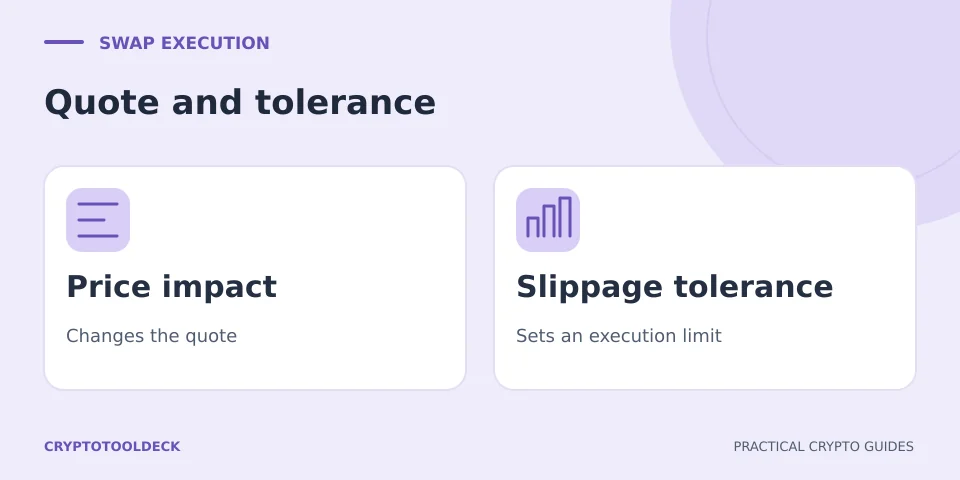
Uniswap’s terminology guide separates the price movement caused by your own trade from the difference between the expected and executed exchange price. A tolerance is a user-selected constraint on execution, not a measurement of either one.
| Term | Question it answers | Common misreading |
|---|---|---|
| Price impact | How does this trade affect the available pricing? | A separate fee you add to the quoted output |
| Execution slippage | How did the execution differ from the quote? | The number selected in the tolerance box |
| Tolerance | What boundary am I authorising? | A guaranteed discount or unavoidable charge |
Pool depth matters. The same notional trade can consume a very different share of available liquidity in two markets. Uniswap’s price-impact explanation connects impact to pool liquidity. A large market capitalisation elsewhere is not proof that the particular route has deep executable liquidity.
One quote, three possible outcomes
Consider an illustrative quote of 1,000 DEMO tokens for a fixed input. You choose an output-decrease tolerance of 0.5%, giving a 995-token minimum before any additional token-rounding issue. The quote is the starting point; do not subtract a displayed price-impact percentage again unless the interface explicitly says it has not been included.
- An execution returning 999 tokens is above that boundary. The output is 0.1% below the quote, not 0.5% below it.
- An execution returning 1,001 tokens is better than the original quote. The selected tolerance is not automatically deducted from this amount.
- An attempted execution returning only 994 tokens would breach this model’s minimum. A transaction enforcing that exact constraint should not complete that swap on those terms.
Those examples describe an enforced, single-swap threshold. They are not a promise that every router implements the same formula, that every token behaves conventionally, or that a failed attempt costs nothing. Use the slippage threshold calculator to compare quantity-decrease and inverse-price conventions. Read the final transaction amounts instead of relying only on the percentage label.
A larger tolerance changes permission, not liquidity
If a quote worsens repeatedly, increasing tolerance expands what you may accept. It does not increase the token reserve, certify the contract or guarantee that you can sell later. Treat “raise slippage until it works” as an incomplete diagnosis, especially for an unfamiliar asset.
Record the input amount, quoted output, route, quote time, displayed costs and final minimum. Then compare like with like: the same token contracts, same input amount and similarly fresh quotes. A quote obtained for a smaller amount is a different trade, not evidence that the original amount can execute at that rate. Splitting transactions may introduce extra costs and changing market conditions.
Keep execution costs separate
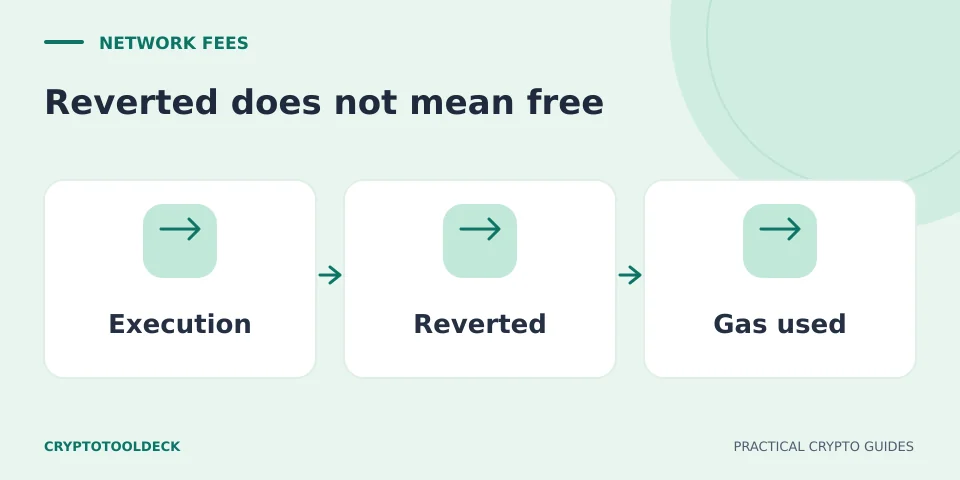
Network fees pay for execution; they are not the tolerance percentage. A reverted on-chain attempt can still incur gas. Uniswap’s swap-failure discussion describes price movement and public transaction exposure among failure causes. Its product-specific execution claims should not be assumed to apply to every route or wallet.
For a decision worksheet, keep four separate entries: the output quote, the enforceable minimum or maximum, the network-cost estimate, and any separately stated interface or token fees. If you cannot tell whether a fee is already included, resolve that before adding percentages together. This avoids making a quote look worse through double-counting—or better by omitting a real cost.
Already have a failed transaction? Start with the failed-swap receipt checklist. If a signature or approval is the confusing part, read Permit2 signatures and token approvals before authorising another step.
Educational information, not a wallet audit, transaction validation or personalised financial advice. Service support and interfaces can change. Report an error with the page URL; never send recovery phrases or private keys.