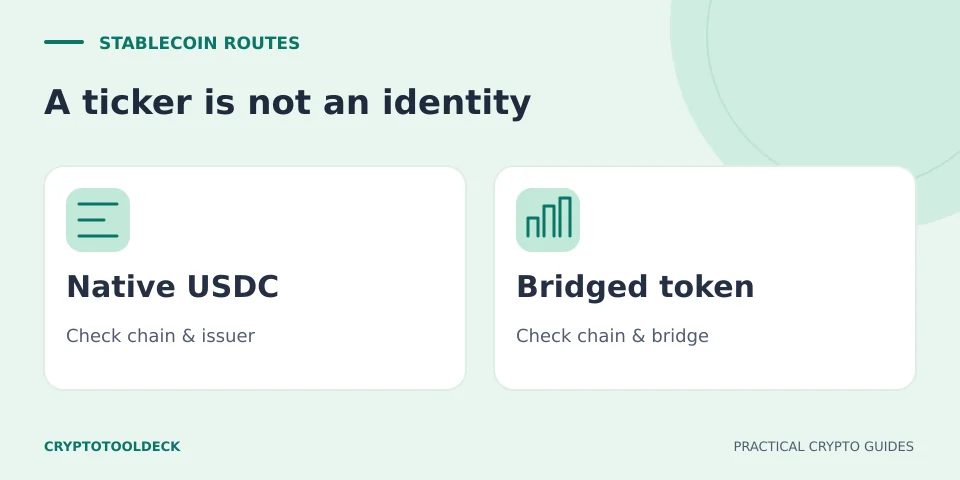
A wallet can display two assets with a similar USDC name even when the contracts, issuers and transfer routes differ. The safe comparison is not “Which logo looks right?” It is “Which token, on which network, does this recipient actually accept?”
Native and bridged describe different issuance paths
Native USDC is issued by Circle on a supported blockchain. A bridged representation typically arises when a bridge holds an asset on one chain and represents it on another. That representation introduces the bridge’s own contracts and operating assumptions. A familiar dollar-denominated ticker does not remove those dependencies.
Circle maintains official USDC contract addresses by blockchain, including a distinction between mainnet and testnet. Use that directory to identify Circle-issued USDC, then separately check the receiving service’s instructions. A contract address in an issuer directory is not your personal exchange deposit address.
Names help you search; they do not prove identity
Some bridged tokens use labels such as USDC.e. Suffixes and wallet display names are not a universal standard, however. A missing suffix does not prove native issuance, and a copied symbol cannot authenticate a contract. The network is part of the identity: matching an address-looking string without checking the chain is incomplete.
Imagine a receiving service instructs you to deposit native USDC on Network A. Your wallet holds a bridged USDC representation on Network A and native USDC on Network B. Neither balance automatically satisfies that instruction. The first differs in token identity; the second differs in network. Sending either because the wallet says “USDC” skips the two checks that matter.
Use a four-field transfer note
Before sending, write down the following information from the current receiving instructions and verify it against the asset you hold:
- Receiving network: the exact network name and, where useful, its chain identifier—not just “EVM”.
- Accepted token: the contract or mint identifier and whether the service specifies native or bridged USDC.
- Deposit destination: your assigned address and any additional required reference, memo or tag.
- Crediting conditions: minimum amount, required confirmations, maintenance notices and any unsupported transfer methods.
If the service does not make the token variant clear, ask its official support before sending. Do not resolve that ambiguity by choosing the cheapest withdrawal option. A network fee comparison cannot compensate for sending an unsupported asset. A small test may help check a route but does not override minimums or establish that future deposits will always be accepted.
Burn-and-mint is different from holding a bridged representation
Circle’s CCTP documentation describes native USDC movement using a burn on the source chain and a mint on the destination. That native transfer flow differs from receiving a third-party wrapped claim created through a lock-and-mint bridge. It still requires a supported path and correctly completed steps.
The practical check is the token delivered at the destination, not the bridge app’s headline. Read the route before authorising it: source token, destination token, fees, expected sequence and how completion is tracked. An exchange’s deposit network menu does not necessarily accept every contract-mediated or cross-chain arrival. Do not assume that an app using a recognised protocol has verified your exchange account’s deposit requirements.
An upgrade path is not a promise
Circle’s Bridged USDC Standard allows certain deployments to be upgraded to native issuance if Circle and the relevant team elect to do so. Circle explicitly describes this as an option, not an obligation. The possibility of a future upgrade does not make every bridged asset native today.
This is also why a saved screenshot or old comparison table can be misleading. For a new transfer, check the current issuer documentation and receiving instructions again. Record the date of the check instead of treating an old token label as permanent.
For the broader pre-send workflow, use the stablecoin transfer checklist. If you already sent funds and see an on-chain confirmation, use confirmed but not credited. Neither native issuance nor a successful transaction guarantees recovery after an unsupported deposit.
Educational information, not a wallet audit, transaction validation or personalised financial advice. Service support and interfaces can change. Report an error with the page URL; never send recovery phrases or private keys.