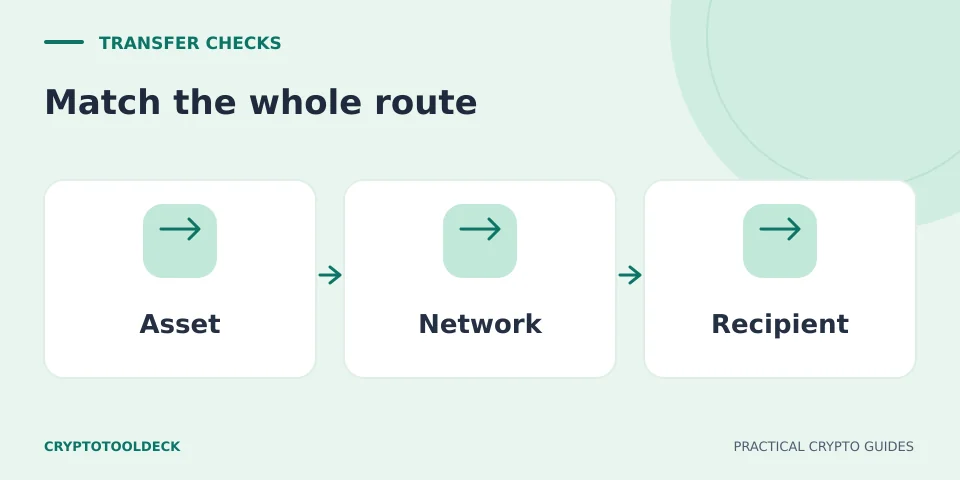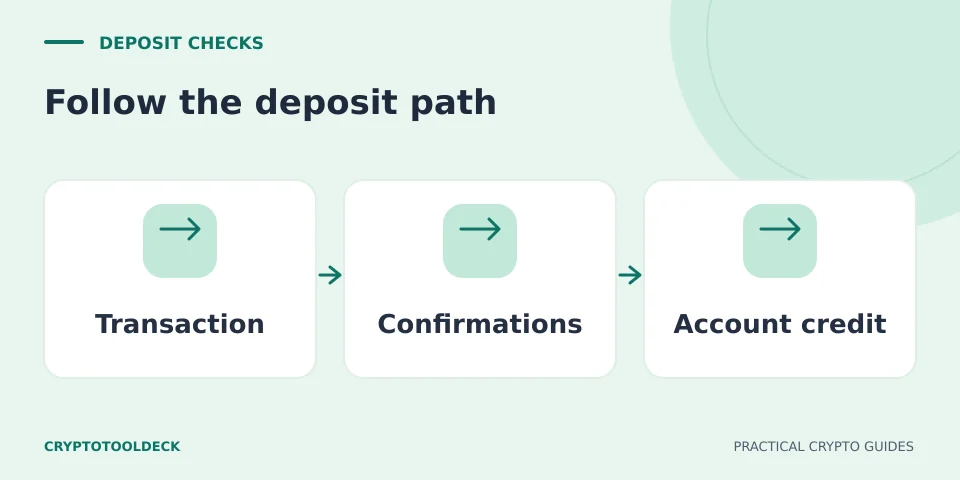
A successful blockchain transaction and an exchange account credit are different events. First verify what arrived on which network. Then compare it with the recipient’s deposit requirements and account status. Do not send another payment simply because the first is missing.
This guide is for a transfer already sent to a custodial exchange or service. If you are still choosing a route, use the USDT pre-transfer checklist. If the destination is your own self-custody wallet, an exchange-crediting investigation is the wrong workflow: start with the chain, address and token balance instead.
Start with the transaction hash, not a sender screenshot
Get the hash from the sending wallet or service and inspect it using the appropriate chain’s explorer. A sender-side “completed” label does not answer whether the destination has credited your account. Coinbase’s pending-transaction guidance starts with the hash and network confirmation status.
Record the chain, status, asset, amount and destination actually shown. For a token transfer, check the relevant token movement rather than assuming every successful contract interaction sent the intended token. If you cannot interpret the record, provide the hash to official support instead of guessing. Never connect a wallet or enter a seed phrase merely to look up a public transaction.
Also distinguish inclusion from the receiving service’s required confirmation count. One service’s threshold is not every service’s threshold. The current asset-specific deposit screen is more useful than a generic promise that crypto arrives in a fixed number of minutes.
Check the route and the account-crediting requirements
| Check | Question to resolve |
|---|---|
| Asset and token version | Did the destination receive the supported asset, not just a token using the same ticker? |
| Network | Was the transfer on the precise chain selected for the deposit? |
| Destination | Does the actual recipient match the address supplied by your account? |
| Memo or tag | Was additional routing information required, and was it included correctly? |
| Amount and confirmations | Did the received amount and confirmation count meet the service’s rules? |
Kraken’s missing-deposit checklist covers these checks, alongside expired addresses and service availability. A correct-looking address alone is not enough. Contact support if the network or memo differs; a successful transaction cannot retroactively add missing deposit instructions.
As a hypothetical example, suppose a service requires 20 tokens and the sender deducts a two-token charge from a 20-token withdrawal. The destination receives 18, below that assumed minimum. The transaction may still be valid on-chain. These numbers are illustrative. Do not assume another transfer will combine with the first to satisfy the minimum; verify the service’s treatment before acting.
If the route checks out, review the receiving service’s official status page and your signed-in account notices. Coinbase’s receive-troubleshooting guidance also calls out account requirements that may need attention. Follow notices inside the verified app or site, not identity-verification links sent by an unsolicited “support agent.”
Send one clear evidence package
A useful initial support request can be short:
My deposit is not credited. Asset/token: [name and contract if relevant]. Network: [chain]. Transaction hash: [hash]. Sent at: [date, time, time zone]. Amount received on-chain: [amount]. Destination: [address]. Memo/tag used: [value or not required]. Current deposit status: [status]. I compared these with the receiving instructions and found: [match or specific mismatch].
Submit this through the recipient’s authenticated help route. Include a redacted deposit-screen image if requested; keep passwords, verification codes and recovery phrases out of the message. Ask whether the transfer can be credited or falls under a recovery policy, and what the official next step is. Avoid opening public posts containing unnecessary account details.
Recovery is conditional, not a payment shortcut
A service may not support recovery for your asset, route or destination. Its control of an address does not by itself promise operational recovery. Kraken’s recovery policy describes case-dependent support and limitations; use your recipient’s actual policy.
Do not pay a stranger to “synchronise” the deposit, share private keys or send funds to unlock it. If someone approaches you in Telegram or WhatsApp after you ask for help, use the signal and recovery-scam checklist before responding. This article cannot recover funds or verify who controls a destination.
Educational information, not a wallet audit, transaction validation or personalised financial advice. Service support and interfaces can change. Report an error with the page URL; never send recovery phrases or private keys.