The useful question is not “Which margin mode is safer?” It is “Which funds can this position draw on, and what else can change that balance?” A small isolated allocation and a large cross-collateral pool can back exactly the same trade quantity. That does not make their account-level consequences identical.
First identify the collateral boundary
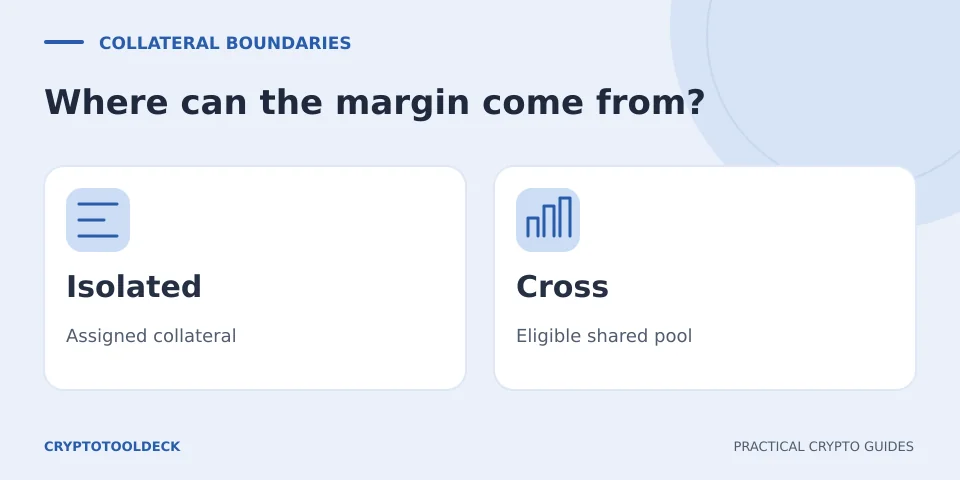
Isolated margin separates the margin assigned to a position from the shared account pool. Cross margin lets eligible balances support positions within the exchange’s specified account arrangement. The word “eligible” matters: do not assume every asset in every wallet is available. Bybit’s comparison of margin modes documents position-based isolated treatment and account-based cross-margin risk measures for its Unified Trading Account. Other providers can organize accounts differently.
| Check | Isolated | Cross |
|---|---|---|
| Which balance supports this position? | The assigned margin, subject to top-up settings | The eligible shared collateral pool |
| What should you monitor? | Allocated funds and changes to that allocation | Other positions, collateral and account obligations |
| What cannot a label establish? | A guaranteed maximum all-in loss | That sufficient collateral will always remain |
Auto top-ups change the meaning of the starting allocation
Imagine a hypothetical account with 600 USDT. You assign 100 USDT to a position and leave 500 USDT available. A note saying “100 USDT initially assigned” records a starting condition. It is not proof that the position can never receive more funds.
Suppose you later add 60 USDT manually. The allocation becomes 160 USDT before subsequent P&L or charges. That simple transfer changes the amount supporting the trade even though the order’s coin quantity has not changed. Track additions explicitly rather than continuing to report the original 100 USDT as the complete collateral exposure.
Automatic transfers deserve the same attention. Bybit’s auto-margin replenishment documentation describes an optional isolated-mode feature that can draw on available account funds as the position approaches its threshold. Its availability and limits are product-specific. “Isolated” and “automatic top-up enabled” can therefore coexist. Moving a threshold is not a guarantee against liquidation.
Cross margin is an account question, not just a trade question
Consider two hypothetical positions sharing a 600-unit balance. If one records a 90-unit loss and the other a 40-unit loss, their combined P&L contribution is minus 130 units, before fees or other changes. Evaluating only the second position’s minus 40 omits a material use of the shared resources. A favorable move in one market also need not offset a loss in another when you need it.
Account grouping is not universal. OKX’s single-currency cross-margin documentation describes sharing within the relevant currency arrangement. Do not reuse that account boundary for a different provider’s multi-asset mode. Write down the actual account, eligible collateral currencies and whether other positions or orders reserve resources.
Margin return is not a collateral stress test
Suppose a 0.5-coin linear long rises from 2,000 to 2,200 quote units. Its gross price gain is 100 units. Dividing by 100 units gives 100%; dividing by 200 gives 50%. Those percentages differ because the denominator differs, not because the price gain changed. Fees would reduce net profit in either case.
Our futures P&L calculator labels its denominator as entry notional divided by leverage. It does not model account maintenance requirements, eligible collateral valuations or a future liquidation path. A positive hypothetical exit result says nothing about whether a position could remain open until that exit.
A short pre-trade record
- Record the product, account mode and current collateral allocation.
- Check manual additions and automatic replenishment separately.
- List other positions and orders using the same eligible balance.
- Read the venue’s trigger and maintenance rules rather than copying a generic liquidation formula.
- Keep the intended stop order separate from the exchange’s liquidation process.
If the chart and account screen show different reference prices, continue with mark, index and last-price differences. Neither changing margin mode nor placing a stop removes execution risk.
Educational information, not a wallet audit, transaction validation or personalised financial advice. Service support and interfaces can change. Report an error with the page URL; never send recovery phrases or private keys.