The last-traded-price candle is not necessarily the price reference used for liquidation. Check the contract and margin mode. In Bybit’s isolated-margin example, liquidation is triggered by mark price reaching the position’s liquidation price. Its cross and portfolio modes instead use an account-level maintenance-margin threshold.
Those are venue-specific rules, not a universal liquidation formula. Bybit describes the distinctions in its order-execution and liquidation FAQ. If you use another exchange, use that exchange’s current contract documentation and account risk display.
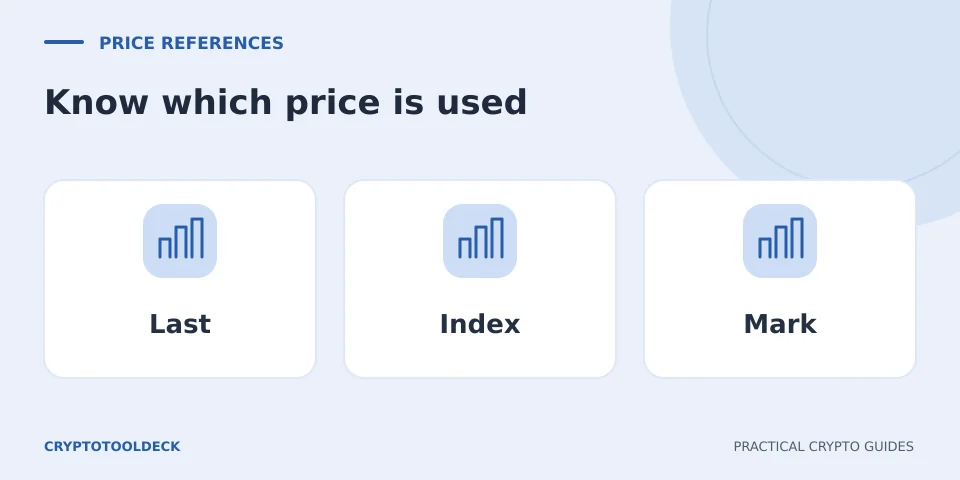
Last, index and mark answer different questions
| Reference | What it represents | What not to assume |
|---|---|---|
| Last traded price | The price of the most recent execution in that market. | That another trade of your size can execute there now. |
| Index price | A reference derived from selected underlying markets. | That it is the bid or ask on your contract’s order book. |
| Mark price | A calculated contract reference used in risk and valuation rules. | That it is a guaranteed closing price. |
Bybit’s P&L FAQ explains why last-price and mark-based unrealized results can differ. A displayed estimate is not a completed sale. Execution price, fees and other charged cash flows still determine the closed trade’s result.
A stop can watch one price while liquidation watches another
Consider a fictional isolated long with an exchange-displayed liquidation price of 90 USD and a stop set to trigger at a last price of 92 USD. At a particular instant, suppose the last price is 93 while the mark is 90. A last-price stop has not met its 92 condition, yet the mark has reached the illustrative liquidation threshold.
This example explains the reference mismatch; it does not claim these prices or thresholds belong to a real contract. Switching to a mark-price chart may explain what happened, but does not undo it. Bybit explicitly warns that a mark-triggered liquidation may not appear on its default last-price candlestick chart in the isolated-margin liquidation documentation.
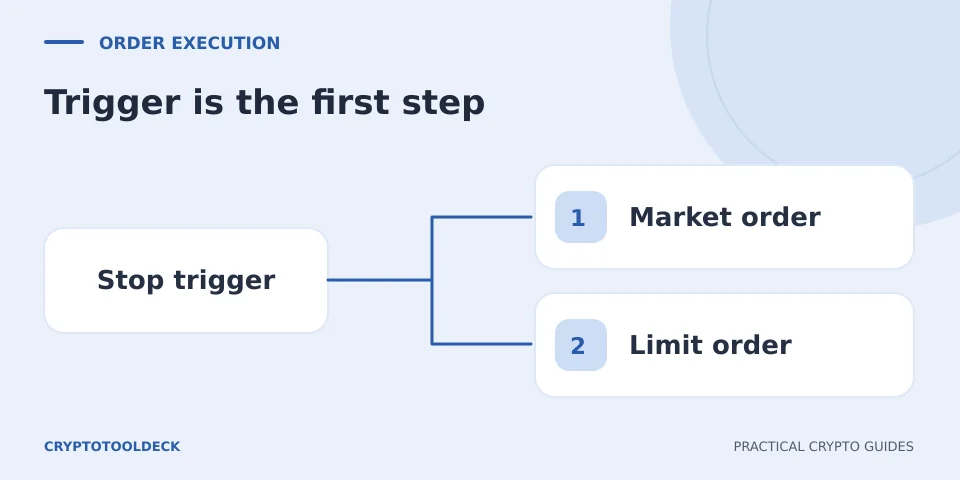
Choosing a mark-based stop, where supported, removes that particular reference mismatch. It does not guarantee a timely fill or make placing a stop near liquidation safe. The stop still activates an order whose execution can differ from the trigger. See Stop-Market vs Stop-Limit for the separate execution problem.
Do not reuse an isolated-position shortcut for a whole account
Bybit’s isolated-mode process evaluates an allocated position separately; its formula includes maintenance margin and contract-specific adjustments, not just entry divided by leverage. The same reference distinguishes linear and inverse contracts. A calculator that silently substitutes one model for the other can produce a plausible but unsuitable number.
For cross or portfolio margin, first inspect the account-level risk measure and the positions or collateral included in it. Bybit’s FAQ gives an account maintenance margin ratio of 100% as its threshold for these modes. That is why this guide does not supply a universal “entry ± 1/leverage” liquidation answer.
What to record when a liquidation surprises you
- Exact product: record the contract symbol, settlement asset and whether it is linear or inverse.
- Margin mode: capture whether the position used isolated, cross or portfolio margin at the time.
- Time and reference: compare the event timestamp with the correct mark, index or last-price history—not only today’s chart.
- Orders and executions: preserve stop settings, trigger source, status, filled quantity and liquidation records. Separate a rejected order from an order that triggered but did not fully fill.
- Account cash flows: check the relevant fee and funding history before equating a chart move with the entire balance change.
Our Funding Fee Calculator can reconcile manually entered settlement assumptions; it does not reconstruct your exchange’s margin engine. For a disputed event, send the records through the venue’s official support channel. A screenshot alone cannot establish whether the exchange followed the contract rules.
Educational information, not a wallet audit, transaction validation or personalised financial advice. Service support and interfaces can change. Report an error with the page URL; never send recovery phrases or private keys.