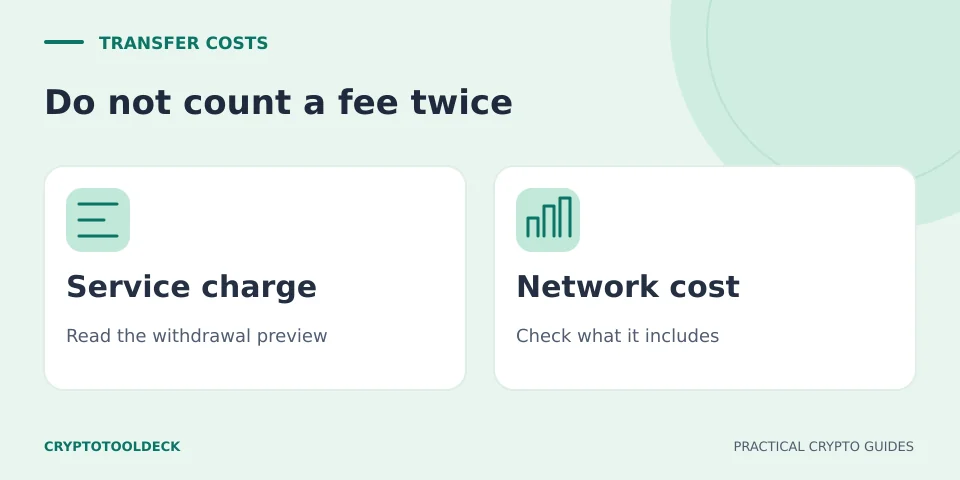
A platform may call a charge a withdrawal fee, network fee, processing fee or estimated miner fee. The name alone does not tell you whether the service pays the blockchain separately, passes through an estimate, absorbs it or adds another charge. Reconcile the final preview instead of adding every label you can find.
Start with three observable numbers
For one withdrawal, record the amount you request, the total asset debit shown to the sender and the amount expected at the recipient. Then record any cost paid separately in another asset or currency. This produces a cash-flow check even when the provider’s terminology is unclear.
| Field | Where to look | Do not assume |
|---|---|---|
| Sender debit | Final confirmation and balance change | It always equals the typed amount |
| Recipient amount | Preview and receiving record | A fixed fee is charged in addition |
| Separate fee | Gas asset, cash balance or itemised preview | It is already included in a token deduction |
Kraken states that withdrawals have minimums and fees, that fees may change and that final fees appear at confirmation. This illustrates why an indexed fee table is discovery information, not proof of what your transaction will cost.
The provider charge can differ from the blockchain payment
Coinbase Exchange explains that it charges based on an estimate of prevailing network fees, while the final network fee it pays can differ because of batching or congestion. In that structure, the user’s withdrawal charge and the on-chain transaction fee are related but are not automatically the same number.
A batched transaction may also include several customer withdrawals. Dividing the transaction’s entire miner or validator fee by one recipient amount is not necessarily how the provider priced that user’s withdrawal. The block explorer shows what happened on-chain; the provider account shows the customer’s debit.
Worked reconciliation
Assume a user requests 1,000 units. The preview says “fee: 3 tokens” and “recipient receives: 997 tokens,” with no separate debit. The direct reconciliation is a 1,000-token sender debit and a 997-token recipient amount. Subtracting another 3 tokens because a help article associates the fee with network costs would count the same displayed deduction twice.
If another preview says the recipient receives 1,000 tokens and the total sender debit is 1,003, the cost is charged in addition. The economic cost is still 3 tokens, but the required balance and recipient amount differ. The Stablecoin Transfer Fee Calculator supports both treatments.
Minimums and support are separate checks
A withdrawal minimum usually checks the amount you request; a deposit minimum may check the amount that arrives. Read the exact provider wording. Passing either number does not establish that the recipient supports the selected network and token contract. Use the network checklist before cost comparison.
Keep dated evidence of the final preview if the amount matters. Do not treat the examples here as current charges for any exchange, token or network.
Educational information, not a wallet audit, transaction validation or personalised financial advice. Service support and interfaces can change. Report an error with the page URL; never send recovery phrases or private keys.