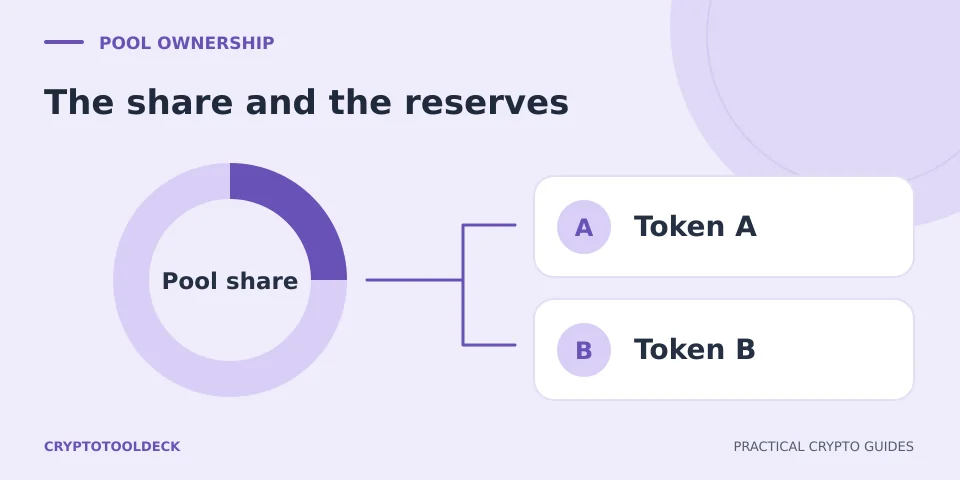
An LP token or position record represents a claim on a share of pool reserves under the protocol’s rules. It is not a fixed promise to return the same quantities originally deposited.
The ownership record and the reserves are different layers
For a basic fungible LP-token pool, your token balance records a fraction of total LP supply. The underlying reserves change as swaps, fees and liquidity additions occur. Uniswap’s v2 documentation explains that liquidity tokens represent a provider’s contribution, are minted on deposit and are burned to retrieve the corresponding underlying liquidity and fee allocation.
Pool-share percentage = LP units held ÷ total LP units outstanding × 100
Underlying Token A = pool Token A reserve × pool-share percentage
Underlying Token B = pool Token B reserve × pool-share percentage
These simplified relationships require values from the same state or block and a pool that uses fungible proportional LP tokens. A concentrated-liquidity NFT position has range-specific accounting and should not be reduced to the same formula without the protocol’s position math.
A smaller percentage can still represent more assets
Suppose you own 10 of 100 LP units, or 10% of a pool holding 1,000 Token A and 20,000 Token B. Your proportional claim is 100 A and 2,000 B. Another provider then adds matching liquidity and receives 100 new LP units. You now own 10 of 200 units, or 5%, but the pool reserves have doubled to 2,000 A and 40,000 B. Your proportional claim remains 100 A and 2,000 B before other changes.
This is percentage dilution without value dilution in the simplified fair-deposit example. If new liquidity is added at an incorrect ratio, if the protocol uses a different minting formula, or if fees and swaps occur between observations, the conclusion requires more detail.
Why token quantities change
Swaps change the reserve ratio. In a constant-product pool, arbitrage can move the pool price toward external markets, leaving providers with more of one token and less of the other. Trading fees can increase reserves or be accounted for separately, depending on the protocol version. Therefore “I deposited 2 ETH” does not mean the position still contains exactly 2 ETH.
Mark both current underlying quantities at prices from the same comparison time. Then compare with the original quantities held outside the pool. The Impermanent Loss Calculator demonstrates this quantity shift only for a full-range 50/50 constant-product model.
Deposit, claim and withdrawal are separate events
Record LP units received on deposit, later additions or removals, fee collection and final assets returned. A dashboard’s current value can include uncollected fees or incentive tokens differently from another dashboard. Before comparing two displays, check whether both use the same pool share, price source, block and reward treatment.
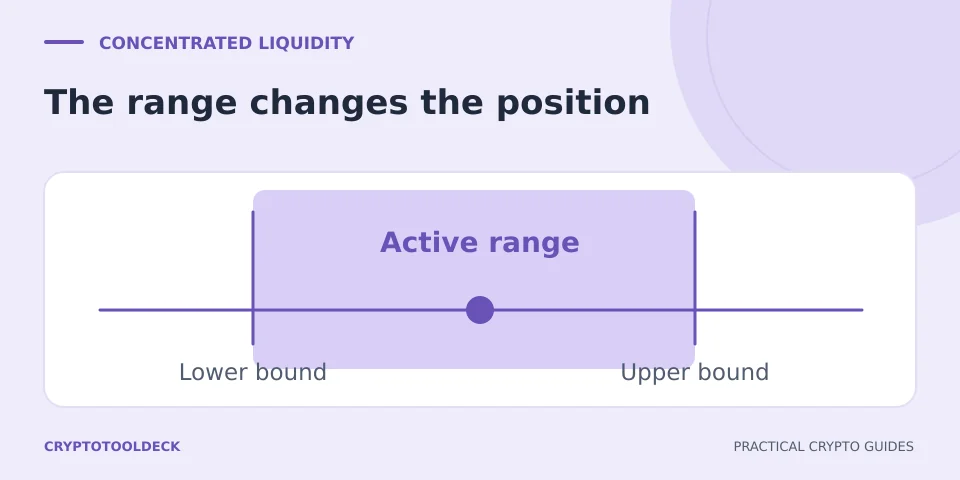
For concentrated liquidity, a position can become single-sided outside its range and stop earning fees until price returns. Read in range vs out of range. For return attribution, keep LP fees and token incentives separate from the underlying reserves.
Educational information, not a wallet audit, transaction validation or personalised financial advice. Service support and interfaces can change. Report an error with the page URL; never send recovery phrases or private keys.