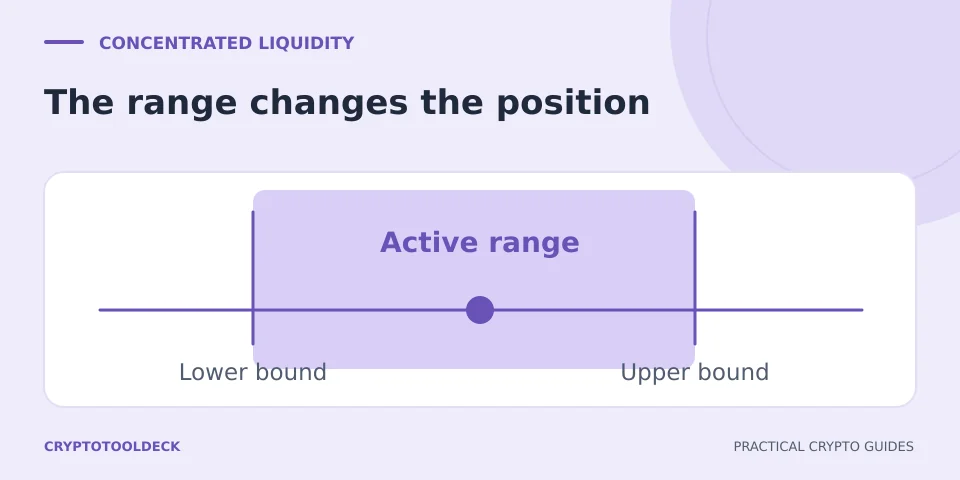
A concentrated-liquidity position supplies liquidity only within a selected price interval. “Out of range” is not just a label on the same 50/50 position: the active status, fee earning and token composition can change.
In range means the current price is inside the position’s interval
When the pool price is within the chosen lower and upper bounds, the position is active and can support swaps in that interval. A narrower interval concentrates more liquidity near the current price, but also makes it easier for a price move to cross a boundary.
Uniswap’s liquidity overview explains that v3 and v4 positions earn fees only while the market price remains within their selected range. It contrasts this with v2, where liquidity is active across all price levels and custom ranges are unavailable.
Out of range becomes single-sided
Uniswap’s support documentation states that out-of-range liquidity is single-sided and does not earn fees until the current price returns to the selected range. Which token remains depends on the range orientation and the direction in which price crossed it.
| State | Typical composition | Fee status |
|---|---|---|
| Inside range | Both tokens, changing with swaps | Active for eligible swap fees |
| Below one boundary | Single-sided in one token | Inactive until price returns |
| Above the other boundary | Single-sided in the other token | Inactive until price returns |
The table describes the mechanism, not a prediction. Collected and uncollected fee accounting, exact boundary conventions and token ordering depend on the protocol and interface.
Why a full-range impermanent-loss formula is insufficient
The common 2√r ÷ (1 + r) − 1 relationship assumes a full-range, equally valued constant-product position. A concentrated position adds lower and upper price bounds. Its starting token ratio can differ from 50/50, and the position can finish entirely in one token. Reusing the full-range formula would discard the inputs that define the position.
Use the Impermanent Loss Calculator only when its explicit full-range assumptions match the scenario. It can help explain relative-price rebalancing; it cannot value a specific v3/v4 NFT position.
Questions to record for a range position
- What is the exact pool, fee tier and token ordering?
- What are the lower and upper bounds in the interface’s price orientation?
- Was the position in range during the period being measured?
- Which fees are accrued, collected or reinvested?
- What are the current underlying token quantities and withdrawal costs?
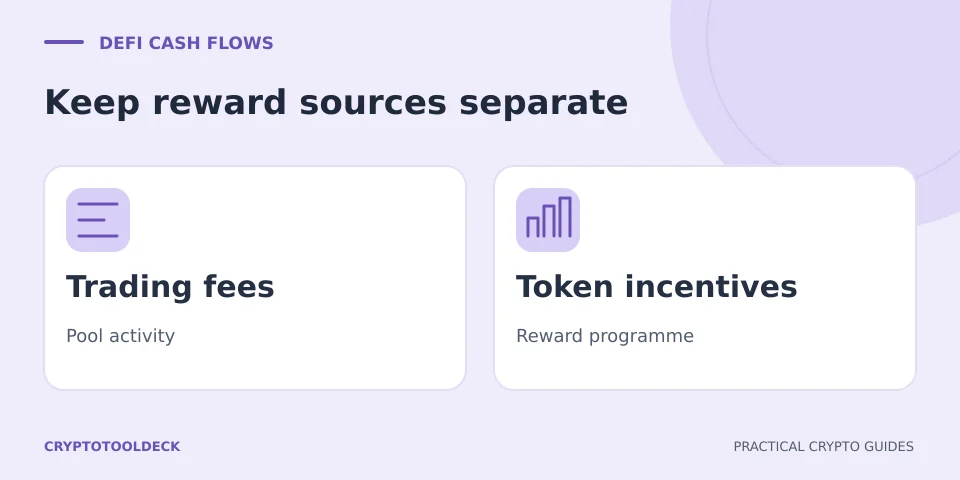
A high displayed APR captured during an active period does not describe a later out-of-range period. Separate the range state from fees and token incentives before comparing returns.
Educational information, not a wallet audit, transaction validation or personalised financial advice. Service support and interfaces can change. Report an error with the page URL; never send recovery phrases or private keys.