An unchanged wstETH balance does not, by itself, mean rewards are missing. stETH and wstETH represent related exposure using different accounting units. Check which token you hold before deciding what should change in your wallet.
Balance changes versus conversion-ratio changes
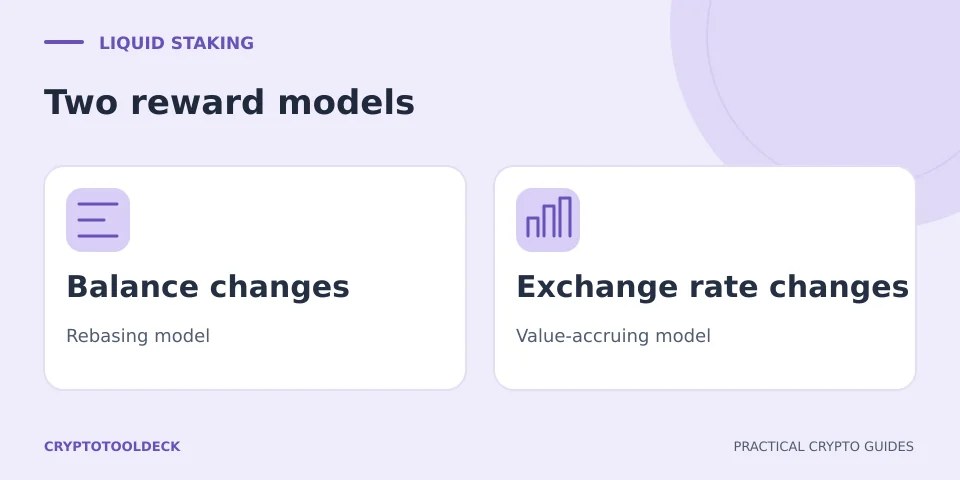
Lido’s token integration guide describes stETH as a rebasing token: its displayed balance can change as protocol accounting is updated, without a conventional incoming transfer for each change. Rebases can reflect positive or negative outcomes, so an increase should not be treated as unconditional.
wstETH is a non-rebasing wrapper. Its token balance does not change merely because of a stETH rebase; the amount of stETH represented by each wstETH changes instead. The wstETH contract documentation describes wrapping stETH into wstETH and unwrapping it back. Transfers, purchases or sales can of course change the number of wstETH units you hold.
| What you inspect | stETH | wstETH |
|---|---|---|
| Wallet units during a rebase | May change | Do not change from the rebase alone |
| Reward representation | Rebasing balance | Changing stETH-per-wstETH ratio |
| Does the display guarantee a fiat gain? | No | No |
A hypothetical conversion example
Assume you hold 2 wstETH and a hypothetical conversion ratio is 1.20 stETH per wstETH. The represented amount is 2 × 1.20 = 2.40 stETH. If the ratio later becomes 1.26, those same 2 wstETH represent 2 × 1.26 = 2.52 stETH. The represented amount increased by 0.12 stETH, or 5%, while the wstETH quantity stayed fixed.
These ratios are invented solely for the example; they are not current Lido rates. Do not add another 5% to the wstETH quantity in the second line. That would count the same exposure twice. If you bought or sold wstETH between observations, separate those flows before attributing the full change to rewards.
The contract ratio is not the market sale price
A conversion ratio answers how much stETH the wrapper represents under the contract’s accounting. A market quote answers what a buyer or pool currently offers for an asset. An ETH or fiat valuation introduces another price relationship. They are different inputs, even when an interface places them together.
For example, knowing that a holding represents 2.52 stETH does not tell you how many dollars a sale will return. You still need the relevant market quote, executable amount and costs. A rising ratio can coexist with a falling fiat value, just as the staking rewards vs token price example demonstrates.
Unwrapping, withdrawing and selling are different operations
Unwrapping wstETH changes the wrapper into stETH. It is not the same as completing a protocol withdrawal into ETH. Lido’s withdrawal-queue documentation describes a request, finalisation and claim process, with an NFT representing the withdrawal claim. Do not assume immediate ETH delivery or a fixed waiting period from an old screenshot.
Selling through a market is a third path, subject to the quote, liquidity and route. Before approving any action, identify its output token and network, not merely a button saying “exit”. An application may combine steps, but the underlying distinctions still matter for what you receive and when.
What to record when a balance looks wrong
Record the exact token contract, network, unit balance, time of observation and the conversion ratio source. Check whether the display is showing wstETH units, an estimated stETH equivalent or a fiat valuation. Compare like units at both times, and account for transfers before drawing a reward conclusion.
Ethereum’s pooled-staking guidance explains that liquid staking introduces additional smart-contract and market-related risks. Holding a wrapper does not remove those risks. This article explains the accounting difference; it does not assess a deployment, recommend holding either token or guarantee a particular redemption value.
Educational information, not a wallet audit, transaction validation or personalised financial advice. Service support and interfaces can change. Report an error with the page URL; never send recovery phrases or private keys.