A pool advertising a low fee has told you only one part of its reward calculation. You still need to know what is being paid for, whether transaction fees are included, how block luck affects credits and when those credits can reach your wallet. Compare those fields before comparing the percentage in a banner.
Three common labels describe different reward bases
In the usual definitions, PPS pays for valid contributed shares using an expected subsidy-based value. FPPS adds an expected transaction-fee component. PPLNS allocates rewards when the pool finds blocks using a defined recent-share window. The historical overview from Luxor’s Hashrate Index explains the progression between these approaches and why smoothing pool luck does not remove changing revenue per unit of hashrate.
| Model | Typical basis | Important question |
|---|---|---|
| PPS | Expected subsidy value for valid shares | Is any transaction-fee reward handled separately? |
| FPPS | Expected subsidy and transaction-fee value | How is the fee component estimated? |
| PPLNS | Reward allocation to a recent-share window when blocks are found | What window applies to work before and after a connection change? |
These are definitions to investigate, not a ranking from best to worst. Names alone do not reveal every pool’s accounting rules. Do not assume FPPS and PPS+ are interchangeable merely because both descriptions mention transaction fees.
A smoother credit is not a fixed cash income
Braiins Pool’s published reward description identifies its FPPS components as subsidy and transaction fees. That documents a named service’s approach; it is not a recommendation to choose that service or evidence that its revenue will stay constant. Your contributed work, network conditions and the currency value of BTC still matter.
For your own ledger, keep at least three quantities separate: eligible work during the period, reward credited in BTC and the currency value assigned to that credit. A daily amount denominated in dollars may change solely because the valuation price changed, even when the BTC amount is identical. Mark the conversion time so that an accounting comparison does not accidentally become a market-price comparison.
Do not subtract the pool fee twice
Consider a purely illustrative gross daily reward valued at 24 currency units and a pool fee of 2%. The fee is 24 × 0.02 = 0.48, leaving 23.52 units before electricity and other costs. If the dashboard instead reports the already-net 23.52 units, applying 2% again would produce 23.0496. The extra 0.4704 deduction is a bookkeeping error, not a second real pool charge.
Our mining cost calculator therefore labels the optional fee as the percentage still to deduct. Enter zero when the chosen revenue amount is already after that charge. Keep withdrawal fees, hosting costs and currency conversion charges separate unless they are demonstrably included in the input.
Credited does not always mean received
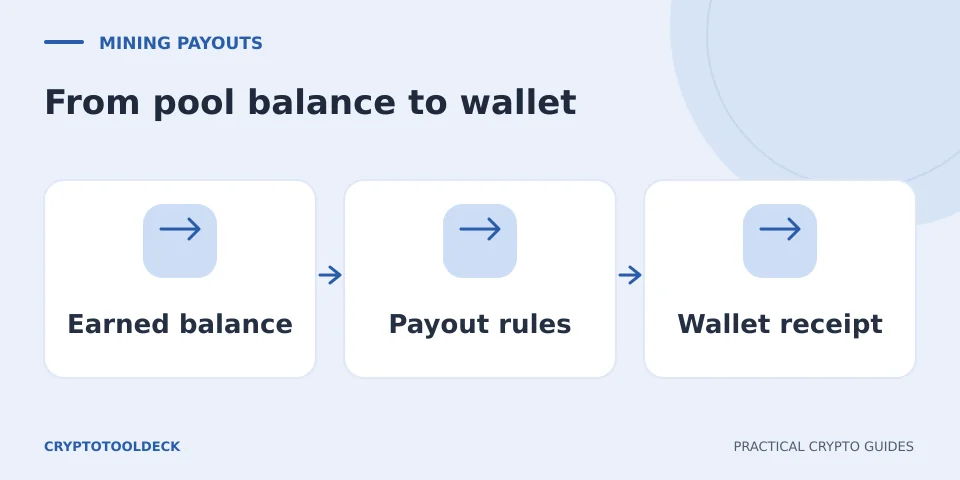
A pool balance and a wallet receipt represent different stages. Check the current minimum payout, schedule, destination requirements and any withdrawal charge in the chosen pool’s own documentation. Braiins’ pool terms distinguish the reward accounting and payout process. Read the applicable terms directly; this page does not assess their legal effect or promise a withdrawal timetable.
A simple reconciliation uses opening pool balance plus new net credits minus actual payouts to explain the closing balance, with any adjustments recorded separately. For example, 0.0004 opening BTC plus 0.0003 credited minus 0.0005 paid leaves 0.0002 BTC. The wallet receipt should be checked independently; do not record both the credit and its later payout as two earnings events.
Compare like periods and document exclusions
- Use matched dates, time zones and accepted-work units.
- Identify subsidy and transaction-fee treatment rather than assuming the same gross basis.
- Check share-window rules before judging a short PPLNS sample.
- Record pool deductions separately from power and hosting bills.
- Keep a provider’s changing fee schedule linked, not copied into a timeless claim.
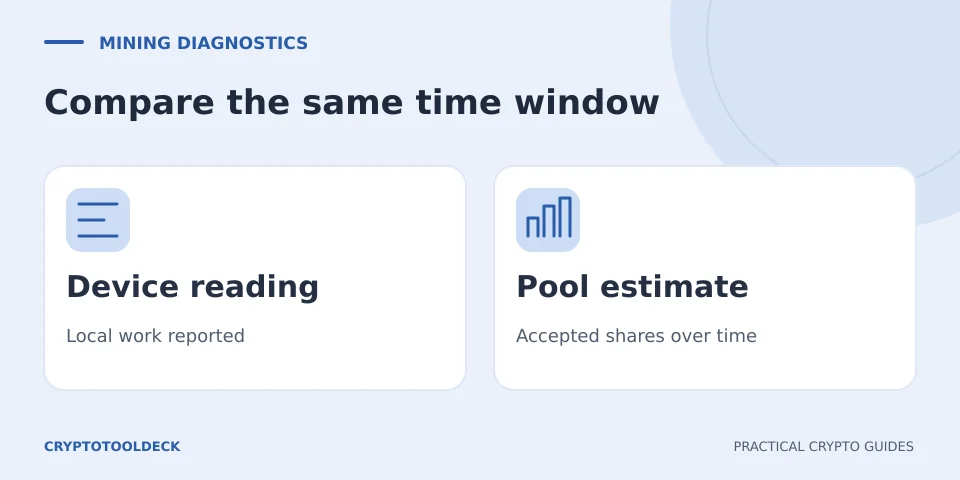
The hashrate versus difficulty guide explains why constant machine output need not produce constant rewards. For differences between the miner display and accepted work, continue with pool-reported hashrate checks.
Educational information, not a wallet audit, transaction validation or personalised financial advice. Service support and interfaces can change. Report an error with the page URL; never send recovery phrases or private keys.