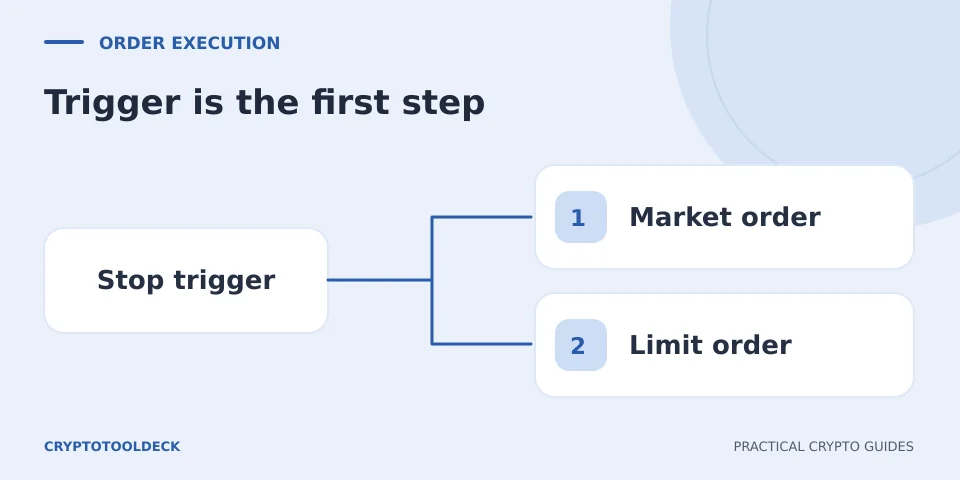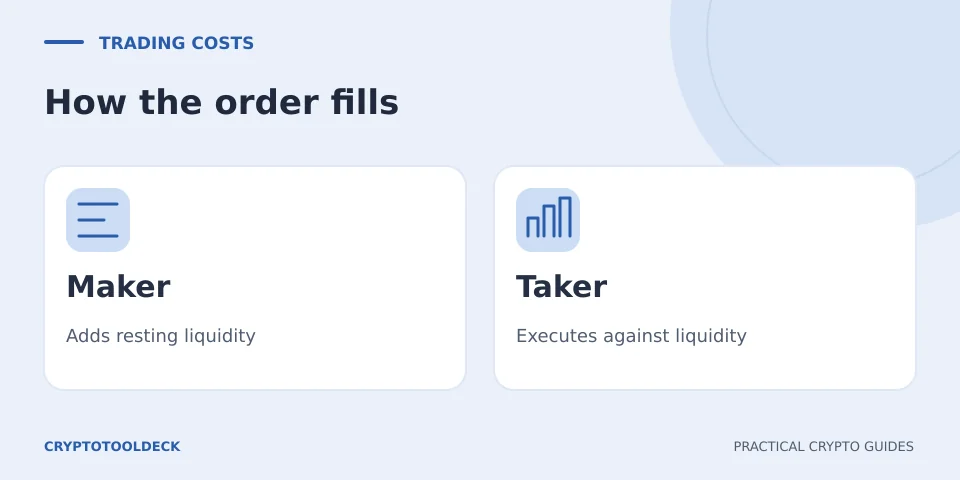
Maker or taker describes how a fill meets the order book—not just which order button you pressed. A limit order that immediately trades against an existing order can pay a taker fee. A resting order can later provide liquidity and receive the maker treatment in that venue’s fee schedule.
The practical question is not “Did I choose Limit?” It is “Which parts of my order filled immediately, which rested, and what did the execution record charge?” Kraken’s limit-order explanation illustrates this distinction. Rates and available order options depend on the venue and product; the numbers below are invented examples, not current exchange pricing.
A limit sets a price boundary, not a liquidity role
Imagine the best available sell offer is 50 USD. You submit a buy limit at 51 USD. Your limit permits buying at 51 or less, so an immediate match at 50 is within your instruction. The order has taken an offer already on the book; typing a limit did not make that execution a maker fill.
Now imagine a buy limit at 49 USD while the best offer remains 50. There is no acceptable seller in this simplified snapshot. The order can rest if its time-in-force permits. If a seller later trades into that resting bid, it has supplied liquidity. The price could also move away and leave it unfilled. Those examples apply the mechanics in Kraken’s documentation; they are not instructions to place a particular order.
One order, two fee calculations
Consider a hypothetical order for ten tokens at a 50 USD limit. Four fill immediately at 50; the other six rest and later fill at 50. Assume a 0.20% taker fee and a 0.10% maker fee, both paid in USD.
| Execution | Filled value | Fee calculation | Fee |
|---|---|---|---|
| Immediate four-token fill | 200 USD | 200 × 0.20% | 0.40 USD |
| Later six-token fill | 300 USD | 300 × 0.10% | 0.30 USD |
| Total | 500 USD | 0.40 + 0.30 | 0.70 USD |
Charging the whole order at the maker rate would produce 0.50 USD and undercount the example by 0.20 USD. Its effective fee rate is 0.70 ÷ 500 × 100 = 0.14%. That blended figure describes these fills only; it is not a new fee tier. With different execution prices, sum each fill’s value before dividing.
Post-only can avoid taking—but can leave you without a trade
Kraken documents post-only as an instruction that either places the order on the book or cancels it if it would immediately trade. It does not promise an eventual fill. Read the exact behaviour on your venue before assuming that a rejected order remains active. See Kraken’s order-options reference.
That creates a real trade-off in a time-sensitive setup: the instruction can preserve the intended liquidity role, but the position you planned may never open. A calculator showing a smaller fee cannot measure the value of that missed execution. Likewise, repeatedly moving a limit to chase the price changes the trade you originally evaluated.
Reconcile the fill record before calculating profit
- Use executions, not the submitted order size. Separate completed fills from the unfilled remainder; Coinbase’s order-management guidance distinguishes order status and filled amount.
- Record the fee currency. A fee in purchased coins changes received quantity. A quote-currency fee changes cash spent or received. A third-token payment needs separate treatment.
- Use the product-specific fee schedule and your actual tier. Do not copy a spot rate into a perpetual-futures worksheet.
- Keep spread and execution price separate from the fee line. A smaller explicit fee does not by itself establish a better all-in trade.
For one complete spot buy and sale with quote-currency fees, the Profit & Loss Calculator shows the cash reconciliation. For multiple purchases or coin-denominated buy fees, use Average Entry. Neither tool imports your account or verifies a fee schedule.
Educational information, not a wallet audit, transaction validation or personalised financial advice. Service support and interfaces can change. Report an error with the page URL; never send recovery phrases or private keys.